
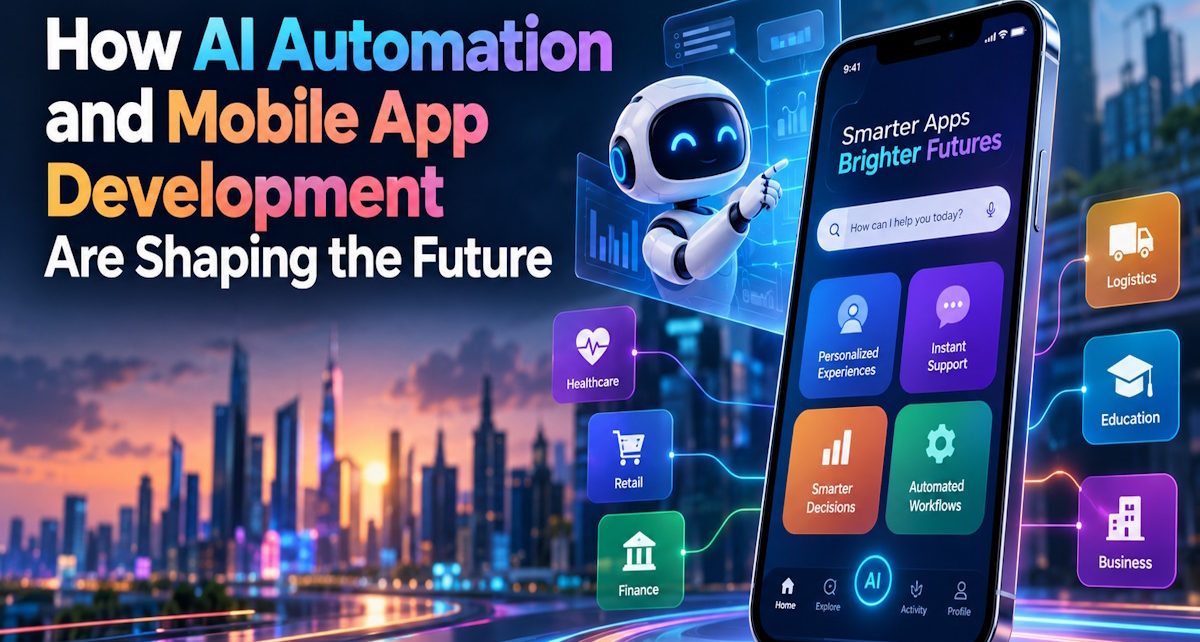
Technology is changing how businesses operate, communicate with customers, and manage daily tasks. Two major forces behind this shift are artificial intelligence (AI) automation and mobile app development. Together, they’re helping companies reduce manual work, improve customer experiences, and build smarter digital products.
Think about how you use your smartphone. You might receive personalized shopping suggestions, get instant answers from a customer support chatbot, or use a banking app that detects unusual transactions. These features rely on AI working behind the scenes.
For businesses, the possibilities go much further.
AI automation can handle repetitive processes, analyze customer behavior, and support faster decision-making. Mobile applications make these capabilities accessible to users wherever they are.
The combination is creating new opportunities across healthcare, retail, finance, education, logistics, and other industries.
But what does this mean for businesses planning their next digital product? And how can companies use these technologies without making their applications unnecessarily complicated?
Let’s explore how AI automation and mobile applications are influencing business operations, customer expectations, and the future of software development.
Understanding AI Automation and Its Role in Modern Businesses
AI automation refers to using artificial intelligence to perform tasks that would otherwise require human involvement.
Traditional automation follows predefined rules. For example, a system might automatically send a confirmation email after someone places an order.
AI-powered automation goes a step further. It can analyze information, recognize patterns, interpret language, and recommend actions based on available data.
Consider an online store receiving hundreds of customer inquiries every day.
Without automation, support representatives must read each message, identify the problem, and respond individually. An AI-powered system can categorize inquiries, answer common questions, and forward complicated issues to the appropriate team.
Employees can then spend more time handling situations that require personal attention.
Businesses are exploring AI automation for several reasons:
- Reducing time spent on repetitive administrative work
- Providing customer support outside regular business hours
- Analyzing large amounts of operational data
- Identifying potential errors in business processes
- Improving product recommendations
- Supporting inventory and demand forecasting
- Helping employees make informed decisions
The goal isn’t necessarily to replace human involvement. In many situations, AI works best when it supports employees rather than making every decision independently.
Businesses that understand this distinction can build practical automation systems that solve real problems.
How Mobile App Development Is Changing Business Operations
Smartphones have become a primary way for customers to interact with businesses.
People use mobile applications to order food, book appointments, transfer money, manage subscriptions, and communicate with service providers.
For companies, a mobile app provides more than another communication channel. It can become a central part of their business operations.
A retail company might use an application to manage loyalty programs and customer orders. A healthcare provider could offer appointment scheduling, prescription reminders, and access to medical records.
A logistics business might develop an app that allows drivers to update delivery statuses while customers track shipments.
These applications help businesses offer services without requiring customers to visit physical locations or contact support teams for every request.
Investing in Mobile App Development also allows companies to create digital experiences tailored to their customers’ needs.
Rather than depending entirely on third-party platforms, businesses can control important parts of the user experience, including navigation, account management, communication, and service delivery.
Still, creating a successful mobile application takes more than writing code.
Developers need to consider performance, security, accessibility, device compatibility, and long-term maintenance.
And increasingly, businesses are asking another question.
How can AI make the application more useful?
The Growing Connection Between AI Automation and Mobile Applications
AI automation and mobile applications serve different purposes, but they can work together to improve how people interact with software.
Mobile applications provide the interface customers use. AI systems process information and support actions that make the experience more relevant.
Imagine a travel booking application.
A basic version allows users to search for flights, compare prices, and complete reservations.
An AI-powered version could also suggest destinations based on previous searches, answer questions about travel policies, and notify users when relevant flight prices change.
The application still performs its original function. AI simply adds capabilities that can reduce the effort required from users.
This approach is appearing across different industries.
Businesses are introducing intelligent search, automated customer assistance, predictive notifications, and personalized content into their mobile products.
The key is selecting features that offer genuine value.
Adding AI to every screen doesn’t automatically create a better application. Sometimes a straightforward search function or well-designed menu works perfectly fine.
Successful products use AI where it solves a specific problem.
1. Personalized User Experiences Are Becoming More Common
Customers don’t always want to scroll through hundreds of options to find something relevant.
Personalization helps applications present information based on user preferences, previous interactions, and current activity.
AI systems can analyze this information and identify patterns that support recommendations.
For example, a fitness application might suggest workout routines based on a user’s goals and completed activities.
A shopping application could recommend products related to previous purchases.
A music streaming platform might suggest songs based on listening habits.
These experiences can make applications easier to use because customers spend less time searching.
For businesses, relevant recommendations may also encourage repeat visits and purchases.
But personalization needs boundaries.
Users should understand what information an application collects and how that information affects their experience. Businesses should also provide meaningful privacy controls.
Collecting unnecessary personal information can create risks without improving the product.
A useful starting point is identifying which customer preferences directly support the application’s purpose.
Then build personalization around those needs.
2. AI Chatbots Are Changing Mobile Customer Support
Customer support is one of the most practical uses of AI automation in mobile applications.
Users often need help with simple questions.
Where is my order?
How can I reset my password?
Can I change my appointment?
What is the refund policy?
An AI chatbot can respond to many of these requests without requiring a support representative to handle every interaction.
This can be particularly useful for businesses serving customers across different time zones.
Chatbots can also help users navigate an application, locate information, or complete certain tasks.
For example, a banking app might use a virtual assistant to explain account features or guide users through a card replacement request.
A retail application could help customers check delivery updates.
That said, automated support has limitations.
Complicated complaints, sensitive financial issues, and unusual situations may require human assistance.
Businesses should make it easy for customers to reach a person when automated responses aren’t enough.
Nobody wants to repeat the same problem five times to a chatbot that keeps giving the wrong answer.
A good support experience combines quick automated assistance with accessible human support.
3. Predictive Analytics Helps Businesses Make Better Decisions
Mobile applications generate information about how customers interact with products and services.
This might include frequently used features, purchasing patterns, session activity, or service requests.
AI-powered predictive analytics can examine historical information to estimate what may happen next.
For example, a food delivery company could analyze previous orders to forecast demand during particular hours.
A retail business might estimate which products are likely to sell during an upcoming promotional period.
A subscription-based application could identify usage patterns associated with customers who may cancel their subscriptions.
These predictions aren’t guarantees.
They’re estimates based on available information, and their accuracy depends on data quality, model design, and changing customer behavior.
Still, they can help businesses plan staffing, inventory, marketing campaigns, and customer retention efforts.
Companies should begin with clearly defined questions.
Instead of collecting every possible metric, ask what business decision the information is supposed to support.
That makes the resulting analysis more useful.
4. Voice Assistants Are Making Applications Easier to Use
Voice-enabled features are becoming a practical option for certain mobile experiences.
Speech recognition allows users to interact with applications through spoken commands instead of typing.
This can be useful when users have limited ability to interact with a screen or prefer hands-free operation.
For example, a navigation application can accept spoken destination requests.
A productivity application might allow users to create reminders or search their schedules using voice commands.
An accessibility-focused application could help users navigate features without relying entirely on touch controls.
AI systems can interpret spoken language and identify the user’s intended action.
Developers still need to account for background noise, different accents, unclear instructions, and recognition errors.
Voice interaction should also be optional where possible.
Not every user wants to speak to an application, particularly in public places.
Offering both voice and traditional controls gives customers more flexibility.
5. AI Automation Is Improving Mobile App Security
Security remains a major concern for businesses developing mobile applications.
Applications may handle customer profiles, payment information, business records, and other sensitive data.
AI can support security teams by identifying patterns that may indicate suspicious activity.
For example, a financial application might detect unusual transaction behavior and request additional verification.
An enterprise application could identify abnormal login attempts or access patterns.
Security monitoring systems may also help teams prioritize potential threats.
These capabilities can support faster investigation, but they shouldn’t be treated as complete security solutions.
AI models can make mistakes, including incorrectly flagging legitimate behavior or missing suspicious activity.
Businesses still need secure authentication, access controls, encryption, regular testing, and appropriate data handling practices.
Developers should also consider the security risks associated with AI features themselves.
If an application sends sensitive information to an external AI service, businesses need to understand how that information is processed and retained.
Security planning should begin during product design, not after the application launches.
6. Automated Testing Is Changing Mobile App Development
Building a mobile application involves more than creating screens and connecting features.
Developers must test how the application behaves across devices, operating systems, network conditions, and user interactions.
Manual testing remains useful, particularly for evaluating usability and unusual situations.
But repeating the same tests after every software update can consume considerable time.
Automated testing tools help teams check whether existing features continue to work after code changes.
AI-assisted tools can also support test creation, identify areas that may require additional coverage, and analyze certain failure patterns.
For example, a development team might use automated tests to check login functionality, payment workflows, and account settings.
If a new update breaks an existing feature, the testing process can help identify the issue before release.
This doesn’t mean developers can skip human review.
Automated tests only check the conditions they’re designed to evaluate, and AI-generated tests may contain errors.
A practical approach combines automated checks with manual testing, code reviews, and feedback from actual users.
The result is a more dependable development process.
7. Healthcare Applications Are Becoming More Helpful
Healthcare is one area where mobile applications and AI automation have several practical uses.
Patients can use mobile apps to schedule appointments, access test results, receive medication reminders, and communicate with healthcare providers.
AI can support some of these experiences by organizing information and identifying patterns.
For example, an application connected to approved health monitoring devices might track measurements and highlight changes that deserve attention.
Administrative systems could help healthcare organizations categorize patient inquiries or manage appointment requests.
Healthcare professionals may also use software tools that assist with documentation and reviewing information.
These applications require careful design.
Medical information is sensitive, and automated recommendations can have serious consequences if they’re inaccurate.
Healthcare software developers must consider relevant privacy laws, clinical requirements, data protection, and the need for professional oversight.
AI should support qualified healthcare professionals rather than replace medical judgment.
Businesses entering this field should involve healthcare experts throughout product planning and testing.
8. Retail and E-Commerce Apps Are Becoming More Customer-Focused
Retail businesses are using mobile applications to make shopping more convenient.
Customers can browse products, compare options, complete purchases, and track orders from their phones.
AI automation adds features that help retailers respond to customer behavior.
Product recommendations are one example.
An application may suggest items based on browsing activity, previous purchases, or stated preferences.
AI can also help businesses categorize products, answer common shopping questions, and forecast inventory requirements.
Some retailers use visual search features that allow customers to find products using images.
Others provide automated assistance for returns, order updates, and product information.
These features can reduce friction during the shopping process.
Still, retailers need to keep the basic purchasing experience simple.
Customers should be able to find prices, understand delivery terms, and complete checkout without unnecessary steps.
AI features should support those tasks rather than distract from them.
9. Financial Applications Are Using AI for Smarter Services
Mobile banking and financial applications have changed how customers access financial services.
Users can check balances, transfer money, pay bills, and review transactions without visiting a branch.
AI can help these applications provide additional assistance.
For example, automated spending categorization can organize transactions into groups such as groceries, transportation, and entertainment.
Budgeting applications may identify recurring expenses and help users understand spending patterns.
Financial service providers can also use AI-supported monitoring to investigate potentially fraudulent activity.
Some applications provide automated answers to common account questions.
These capabilities can improve convenience, but financial software needs particularly careful controls.
Incorrect recommendations, unauthorized access, or misleading transaction information can create significant problems.
Developers should prioritize accuracy, security, transparency, and regulatory requirements.
Customers should also have access to clear explanations and human assistance when dealing with important financial decisions.
10. AI-Powered Mobile Apps Are Supporting Remote Work
Remote and distributed teams depend on digital tools to communicate and manage responsibilities.
Mobile applications allow employees to access work information even when they’re away from their desks.
AI automation can support these workflows by reducing routine administrative tasks.
For example, a project management application might summarize task updates or help employees locate relevant documents.
A scheduling application could suggest meeting times based on availability.
A customer relationship management system might organize follow-up reminders or categorize incoming requests.
These features can reduce the amount of manual coordination required.
But businesses should avoid automating processes without understanding how employees actually work.
A feature that looks useful during planning might create extra steps in practice.
Before introducing automation, companies should ask employees which tasks consume the most time and where mistakes commonly occur.
That feedback can guide product decisions.
Challenges Businesses Face When Combining AI and Mobile Apps
Although AI automation offers useful capabilities, businesses can encounter obstacles during development.
One common challenge is cost.
AI-powered features may require specialized development skills, cloud services, ongoing model usage fees, and additional testing.
Another challenge is data quality.
An AI system trained or configured using incomplete information may produce unreliable results.
Privacy is another concern.
Businesses need to determine what information their applications collect, where it’s stored, and who can access it.
There are also technical considerations.
Some AI features require continuous internet connectivity, while others can run directly on mobile devices.
Each approach affects application performance, operating costs, and data handling.
User trust matters too.
If customers don’t understand why an application makes certain recommendations, they may hesitate to rely on it.
Companies can address these challenges through careful planning, limited initial releases, testing, and clear communication.
Starting with one useful AI feature is often more manageable than introducing several complicated capabilities at once.
How Businesses Can Prepare for AI-Powered Mobile App Development
Businesses considering AI-powered mobile applications should begin with their actual operational needs.
A clear problem statement makes technology decisions easier.
Here are practical steps to follow.
Identify the Problem Before Choosing the Technology
Start by examining where customers or employees experience difficulties.
Are support requests taking too long?
Do customers struggle to find relevant products?
Is manual data entry creating unnecessary work?
Once you’ve identified the problem, determine whether AI is the right solution.
Some issues can be solved with simpler application features.
Choose Features Based on Customer Value
Prioritize capabilities that make the application easier to use or improve an important business process.
A customer support chatbot might be useful for a service business receiving frequent inquiries.
Predictive inventory features may be more relevant for a retailer.
Different businesses need different solutions.
Plan Your Data Requirements
AI features depend on appropriate information.
Businesses should identify what data is needed, whether it’s reliable, and how it will be protected.
They should also establish rules for data access, retention, and user consent.
Build a Small Initial Version
Rather than developing every planned feature immediately, create a limited version focused on the most important use case.
This allows teams to test assumptions and collect feedback before making larger investments.
Test With Real Users
Technical performance is only part of the evaluation.
Businesses should observe whether customers understand the features and find them useful.
If users repeatedly ignore an AI recommendation or struggle with an automated workflow, the design may need adjustment.
Monitor Performance After Launch
Mobile applications require ongoing attention.
Teams should review application crashes, response times, customer feedback, operating costs, and the accuracy of AI-supported features.
Regular updates help address problems as customer needs change.
What the Future Holds for AI Automation and Mobile Applications
Several developments are likely to influence how businesses build mobile products over the coming years.
One is greater use of on-device AI.
Instead of sending every request to a remote server, certain AI tasks can run directly on supported smartphones.
This can reduce network dependence for specific features and may offer privacy benefits when sensitive information stays on the device.
Another development is more natural interaction.
Users may increasingly communicate with applications through conversational interfaces, voice commands, and image-based searches.
AI-powered assistance could also become more closely connected to everyday tasks.
For example, a travel application might help users compare transportation options and organize booking details within a single experience.
Business applications may offer more automated reporting, scheduling assistance, and workflow management.
Developers are also gaining access to tools that help them build and test AI-powered features.
Still, the future won’t depend on AI alone.
Application speed, accessibility, privacy, and ease of use will remain central to product quality.
Businesses that focus only on adding new technology may overlook what customers actually need.
The more useful question is whether a feature saves time, solves a problem, or makes a service easier to access.
Why Choosing the Right Development Partner Matters
Creating an AI-powered mobile application requires several areas of expertise.
Businesses may need support with mobile interface design, backend development, data management, AI services, security, and software testing.
Working with an experienced software development partner can help companies assess technical requirements before committing to a particular approach.
A development team should understand the business problem, target audience, and expected outcomes.
They should also explain the trade-offs between different technologies.
For example, a company may need to decide between native mobile development and a cross-platform approach.
It may also need to determine whether an existing AI service meets its requirements or whether a more specialized solution is necessary.
Cost planning is another important consideration.
The initial development budget should account for future maintenance, cloud usage, security updates, and feature improvements.
Businesses should ask potential development partners how they handle testing, privacy, performance, and ongoing support.
Clear communication during the planning stage can prevent expensive changes later.
Building Smarter Mobile Experiences Starts With Practical Decisions
AI automation and mobile applications are changing how businesses deliver services and manage daily operations.
From personalized shopping experiences to automated customer support, predictive analytics, and security monitoring, these technologies offer several ways to improve digital products.
But successful applications aren’t defined by the number of advanced features they contain.
They’re defined by how well they serve their users.
Businesses should focus on specific problems, select appropriate technologies, protect customer information, and test their products carefully.
The same principle applies whether you’re building a customer-facing shopping app or an internal application for employees.
Start with what people need.
Then determine where automation can make the experience better.
Companies that take this approach will be better prepared to create mobile products that remain useful as technology and customer expectations change.
And if you’re planning your next mobile application, now is a good time to evaluate which AI-powered features could genuinely improve your business.