

Businesses have spent years investing in software to make work easier. Yet employees still copy information between systems, spend hours preparing reports, and struggle to find useful insights buried in company data.
Generative AI and Machine Learning are starting to change that.
A sales manager can review months of customer activity without manually examining every record. A customer support team can resolve routine questions without keeping customers waiting. Developers can spend less time writing repetitive code and more time solving complex problems.
These aren’t distant possibilities. Businesses are already applying these technologies to everyday operations.
Still, there’s a difference between adopting AI tools and getting meaningful results from them. Adding a chatbot to your website won’t automatically improve customer satisfaction. Generating hundreds of marketing emails won’t help if the messages don’t address what customers actually need.
The real value comes from understanding where these technologies fit, what problems they can solve, and how to use them without creating unnecessary complexity.
Let’s explore what’s changing across different business functions and what you should consider before making your next technology investment.
Generative AI and Machine Learning: Understanding the Difference
Generative AI and Machine Learning are closely related, but they aren’t interchangeable.
Machine Learning focuses on finding patterns in data. Businesses use it to predict customer behavior, identify unusual transactions, forecast demand, and recommend products.
Think about an online retailer trying to estimate how many winter jackets it should stock. A Machine Learning model can examine previous sales, seasonal demand, pricing, and purchasing patterns to estimate future requirements.
Generative AI handles a different kind of work. It creates content, including text, images, code, and structured responses, based on patterns learned during training.
A retailer could use it to draft product descriptions, answer customer questions, or summarize inventory reports.
The distinction becomes particularly useful when both technologies work together.
A Machine Learning system might identify customers who are likely to cancel a subscription. A generative application could then help the retention team prepare personalized outreach based on approved customer information.
One technology identifies a pattern. The other helps people respond to it.
Of course, Generative AI itself relies on Machine Learning methods. The practical difference lies in what businesses ask these systems to accomplish.
Why Businesses Are Rethinking Their Existing Workflows
For many organizations, the biggest obstacle to growth isn’t a lack of software. It’s the amount of manual work required to keep existing systems running.
Consider a company where customer information sits in a CRM, invoices are stored in accounting software, and operational reports are maintained in spreadsheets.
Employees may need to move between these systems just to answer a basic question about customer profitability.
That takes time. It also increases the chances of missing information.
AI applications can help employees retrieve, organize, and interpret information without repeating every manual step.
But the opportunity isn’t limited to automation.
Businesses can also use these technologies to make better decisions, identify operational problems earlier, and deliver services that respond more closely to customer needs.
The starting point should be a business problem, not a software feature.
Ask a simple question: Which activities would produce better results if your employees had faster access to reliable information?
The answer often reveals opportunities worth investigating.
1. Customer Support Is Moving Beyond Scripted Chatbots
Traditional customer service chatbots usually follow predefined conversation paths.
They work reasonably well when customers ask predictable questions. Problems arise when someone uses unexpected wording or needs help with an issue that doesn’t match the available options.
Generative AI allows businesses to build conversational assistants that interpret questions and prepare responses using relevant information.
A customer might ask, “My package hasn’t arrived, and I’m leaving town tomorrow. What can I do?”
Instead of displaying a generic shipping policy, a properly connected assistant could check the order status, identify available delivery options, and explain the next steps.
That requires access to accurate order information and clear rules about which actions the assistant can perform.
The Opportunity Beyond Faster Responses
Customer service conversations contain useful information about products, policies, and recurring problems.
Machine Learning can categorize these interactions and identify patterns.
Suppose a software company receives a growing number of support requests after releasing a new feature.
Rather than treating each ticket as an isolated issue, the company can analyze the conversations to identify where customers are getting stuck.
Product managers can use those findings to improve the interface, revise instructions, or address software defects.
Customer support then becomes a source of product feedback rather than just a department that resolves complaints.
What Businesses Should Do
Start with a limited set of common support requests. Connect the assistant to approved information sources and define when it must transfer conversations to employees.
Measure resolution accuracy, repeat contact rates, customer satisfaction, and the number of issues requiring human intervention.
A lower support cost means little if customers repeatedly receive incorrect answers.
2. Business Decisions Are Becoming More Data-Driven
Most businesses collect more data than their employees can reasonably review.
Sales records, customer feedback, website activity, financial reports, and operational systems all produce information that could influence decisions.
The challenge is finding useful patterns before the information becomes outdated.
Machine Learning can help businesses identify relationships that aren’t immediately obvious through manual analysis.
For example, a subscription software provider might discover that customers who stop using a particular feature are more likely to cancel their accounts.
That finding gives the customer success team something specific to investigate.
They could contact affected customers, offer product guidance, or examine whether the feature has usability problems.
Generative AI can make these findings easier to access by allowing employees to ask questions in natural language.
A manager might ask, “Which customer segments had the largest decline in renewals over the last six months?”
A connected reporting assistant could retrieve relevant figures and prepare an explanation.
The Detail That Matters
An AI-generated explanation should never replace the underlying evidence.
Businesses need systems that show where answers came from, which data was used, and whether the results are complete.
For high-impact decisions, employees should be able to inspect the supporting records.
Otherwise, a convincing explanation may create more confidence than the evidence deserves.
3. Marketing Teams Can Produce More Relevant Customer Experiences
Marketing departments are under pressure to create content for multiple channels while maintaining consistent messaging.
Generative AI can assist with campaign planning, copywriting, audience research, and content variations.
But producing content faster isn’t necessarily the most valuable application.
The bigger opportunity lies in understanding which messages matter to different customers.
Machine Learning can analyze purchase history, browsing behavior, and engagement patterns to identify meaningful customer groups.
A software business, for instance, may discover that trial users who complete a particular setup process are more likely to become paying customers.
Instead of sending every trial user the same promotional sequence, the marketing team could create communication based on onboarding progress.
Customers who haven’t completed setup might receive practical guidance. Those already using the product could receive information about advanced features.
Generative tools can help prepare these messages while marketers review their accuracy, relevance, and tone.
Why Human Editorial Judgment Still Matters
Generated content often sounds acceptable at first glance.
Read it closely, though, and the problems become easier to spot.
The writing may repeat familiar claims, overlook customer concerns, or describe benefits without explaining how they work.
Strong marketing content needs more than correct grammar.
It should reflect actual customer questions, product knowledge, and the company’s position in the market.
Use AI to support research, develop outlines, and prepare early drafts. Let experienced marketers refine the argument, check claims, and remove content that adds little value.
Your audience doesn’t need more words. They need answers worth reading.
4. Software Development Is Becoming More Focused on Problem-Solving
Software development involves far more than writing code.
Developers review requirements, understand existing systems, troubleshoot problems, write tests, and maintain applications after release.
Generative AI can assist with several of these responsibilities.
Coding assistants can suggest functions, explain unfamiliar code, prepare documentation, and help developers explore possible solutions.
For an experienced developer, these capabilities can reduce time spent on repetitive tasks.
For someone working with an unfamiliar codebase, they may also make it easier to understand existing components.
But generated code needs the same scrutiny as code written by a person.
It may contain security weaknesses, incorrect assumptions, unnecessary dependencies, or logic that fails under unusual conditions.
The Growing Role of Custom AI Applications
Businesses are also exploring Generative AI Development to build applications that address their own operational requirements.
Consider a manufacturing company with thousands of equipment manuals, maintenance records, and troubleshooting documents.
Employees may spend considerable time searching for information about a particular machine.
A custom application could allow authorized technicians to ask questions and retrieve answers grounded in approved documentation.
The system could also provide references to the source material so employees can verify technical instructions.
This approach is often called retrieval-augmented generation, or RAG.
Rather than relying only on information learned during model training, the application retrieves relevant documents and uses them to prepare a response.
It’s particularly useful when businesses need answers based on private or frequently updated information.
Why Architecture Decisions Matter
A custom AI application requires careful planning around several questions.
Where will business information be stored? Who can access it? How will the application retrieve relevant records? What happens when the system cannot find a reliable answer?
Development teams also need to consider response time, operating costs, monitoring, and how the application will interact with existing software.
A well-designed system should be able to decline an unsupported request rather than invent an answer.
That behavior may seem less impressive during a demonstration, but it becomes essential when employees depend on the application for real work.
5. Financial Operations Can Benefit From Smarter Automation
Finance departments handle repetitive tasks that require accuracy and careful recordkeeping.
Invoice processing, expense classification, reconciliation, and financial reporting are common examples.
Machine Learning can help identify unusual transactions, categorize expenses, and detect patterns that may indicate errors or fraud.
Generative tools can assist employees with reviewing financial documents, preparing report summaries, and explaining changes between reporting periods.
Imagine a finance manager reviewing an unexpected increase in operating expenses.
A connected system could identify the categories responsible for the increase and summarize the supporting transactions.
The manager would still verify the findings before taking action.
Where Automation Needs Clear Boundaries
Financial processes often involve approvals, regulatory requirements, and confidential information.
An application that drafts an expense report presents different risks from one authorized to release payments.
Businesses should distinguish between systems that recommend actions and systems permitted to execute them.
For sensitive transactions, approval controls and audit records remain necessary.
Start by automating document classification or information retrieval before considering workflows that directly affect financial accounts.
6. Sales Teams Can Spend More Time With Customers
Sales representatives often spend hours updating CRM records, researching prospects, preparing follow-up emails, and summarizing meetings.
Some of that work can be supported by Generative AI.
For example, an assistant could turn meeting notes into a structured summary, identify unanswered customer questions, and draft a follow-up message.
Machine Learning can help sales teams analyze historical opportunities to identify characteristics associated with successful deals.
A business might discover that customers from certain industries require longer sales cycles or that specific product demonstrations are associated with higher conversion rates.
These insights can inform sales planning.
But there’s a risk in treating lead scores as unquestionable facts.
Historical data may reflect outdated sales practices or incomplete customer information.
Sales managers should review the factors influencing predictions and compare them with current market conditions.
The objective is to give representatives better information, not replace their judgment with a score.
7. Supply Chains Can Become More Predictable
Supply chain management involves decisions about purchasing, production, inventory, and delivery.
Small forecasting errors can create substantial costs.
A business that orders too much stock may face storage expenses and unsold products. Ordering too little can result in delayed deliveries and lost revenue.
Machine Learning can analyze historical sales, seasonal demand, supplier performance, and other relevant factors to support inventory planning.
Manufacturers can also use predictive maintenance models to examine equipment readings and identify patterns associated with potential failures.
Generative AI offers a different form of assistance.
Employees can use it to summarize supplier communications, search operational records, and prepare reports about delayed shipments.
Connecting Predictions to Real Decisions
A demand forecast is useful only when employees know how to act on it.
Suppose a model predicts higher demand for a particular product.
The purchasing team still needs to consider supplier lead times, warehouse capacity, purchasing budgets, and the cost of holding additional stock.
Businesses should design workflows that connect predictions to these operational constraints.
Otherwise, sophisticated forecasting tools may produce interesting reports without improving purchasing decisions.
8. Human Resources Can Improve Training and Internal Support
Employees frequently need information about workplace policies, benefits, training requirements, and internal procedures.
HR teams often answer similar questions repeatedly.
A generative assistant connected to approved company documents can help employees find information without searching through multiple portals.
The assistant might explain the steps for requesting leave or direct employees to the correct benefits documentation.
Generative tools can also support the preparation of onboarding materials, training exercises, and internal communications.
Machine Learning can help learning platforms recommend training based on job responsibilities and completed courses.
A More Practical Approach to Employee Learning
Consider a software company introducing a new development framework.
Instead of giving every employee identical training material, the company could organize learning paths based on experience and job requirements.
Employees might receive explanations, coding exercises, and practice questions suited to their current knowledge.
Managers could review training progress and identify areas requiring additional instruction.
Employment decisions deserve particular care.
Automated recommendations involving recruitment, promotion, or performance evaluation should be reviewed for accuracy, fairness, and compliance with applicable requirements.
9. Cybersecurity Teams Can Identify Problems Earlier
Businesses operate across cloud platforms, internal networks, mobile applications, and connected services.
Monitoring all that activity manually is difficult.
Machine Learning can help identify unusual login behavior, suspicious transactions, unexpected data transfers, and other patterns requiring investigation.
Generative AI can assist security analysts by summarizing alerts, organizing incident information, and explaining technical findings.
For example, an analyst investigating repeated failed login attempts could use an assistant to review related records and prepare an initial incident summary.
The analyst would then determine whether the activity represents a genuine threat.
Why Security Applications Need Extra Testing
Security-related outputs can be misleading when the underlying information is incomplete.
A system may incorrectly classify harmless activity as suspicious or overlook a genuine attack.
Generative applications may also be exposed to malicious instructions hidden inside documents or retrieved content.
Businesses should test how these applications handle untrusted information, restrict their permissions, and monitor their behavior.
Security teams need reliable evidence and clear escalation procedures, not just faster summaries.
10. Customer Experiences Can Become More Personalized
Personalization has traditionally relied on customer segments, recommendation engines, and predefined rules.
Machine Learning allows businesses to identify more detailed patterns in customer behavior.
An online retailer can recommend products based on previous purchases and browsing activity.
A streaming service can suggest content related to viewing preferences.
Generative AI introduces conversational interactions into these experiences.
Customers may be able to describe what they need rather than navigating through multiple categories.
Someone shopping for business software could explain their team size, existing tools, budget, and operational challenges.
A properly designed assistant could ask relevant follow-up questions and suggest suitable options based on verified product information.
The challenge is maintaining accuracy.
If an assistant recommends a product that lacks a required feature, the conversation may damage customer trust.
Businesses should connect recommendations to current product information and clearly distinguish confirmed features from suggestions.
The Hidden Challenges Behind AI Adoption
The benefits of artificial intelligence are appealing, but business results depend on several less visible factors.
Poor Data Can Undermine Good Technology
A forecasting model trained on inconsistent sales records may produce unreliable predictions.
A generative assistant connected to outdated policy documents may give employees incorrect instructions.
Before investing in complex applications, businesses should review the quality, ownership, and accessibility of their information.
Data preparation may not attract much attention during project planning, but it can determine whether the final application works as intended.
Operating Costs Can Grow Unexpectedly
Generative applications may incur charges based on usage, model selection, and the amount of information processed.
A system that performs well during a small pilot may become expensive when hundreds of employees use it throughout the day.
Development teams should measure cost per task, response time, and resource consumption.
Not every request needs the most capable model.
Simpler models, traditional software rules, or standard search functions may handle some tasks at a lower cost.
Choosing the right approach for each activity can help control long-term expenses.
Accuracy Needs to Be Measured
A demonstration showing five successful responses doesn’t prove an application is ready for business use.
Teams should test applications against realistic questions, incomplete information, unusual requests, and situations where the correct response is to acknowledge uncertainty.
For document-based assistants, evaluate whether answers are supported by the retrieved information.
For forecasting models, compare predictions with actual results over time.
For customer support systems, review whether customers receive correct answers and complete their intended tasks.
Testing should continue after deployment because business information and user behavior can change.
Employees Need Clear Responsibilities
Introducing AI can create confusion about who is responsible for reviewing outputs.
If a generated report contains incorrect information, who checks it before distribution?
If an assistant recommends an action, who approves it?
Businesses should define these responsibilities before expanding adoption.
Employees also need practical training on what the systems can do, where they may fail, and how to report problems.
A Practical Framework for Building an AI Strategy
Businesses don’t need to introduce artificial intelligence across every department at once.
A structured approach can help identify projects with measurable value.
Start With Workflow Analysis
Examine how employees complete important tasks.
Look for repeated manual steps, delays, data entry problems, and activities that require searching across multiple systems.
Talk to the people performing the work.
They often understand operational difficulties that aren’t visible in management reports.
Rank Opportunities by Business Value
Evaluate potential projects based on expected benefits, technical complexity, available data, and operational risk.
A customer support assistant handling common account questions may be easier to test than a system making financial decisions.
Choose an initial project where success can be measured and mistakes can be managed.
Establish a Baseline
Before introducing a new tool, record how the existing process performs.
Measure relevant factors such as processing time, error rates, customer satisfaction, or employee workload.
Without a baseline, it becomes difficult to determine whether the technology actually improved anything.
Build a Limited Pilot
Start with a controlled group of users and a defined set of tasks.
Test the application using realistic business information and collect feedback from employees.
Pay attention to unsuccessful interactions, not just successful ones.
Failures often reveal missing documents, unclear requirements, or problems with system access.
Evaluate the Full Cost
Include development, software subscriptions, cloud resources, maintenance, testing, security, and training.
Compare these expenses with measurable business benefits.
A project that saves employee time may still be difficult to justify if operating costs exceed the value created.
Expand Based on Evidence
If the pilot delivers useful results, increase its scope gradually.
Monitor performance as more employees begin using the application.
Continue reviewing accuracy, costs, security, and user feedback.
A successful pilot is a starting point, not proof that the same approach will work equally well everywhere.
What Businesses Should Expect Next
Artificial intelligence is becoming part of the software employees already use.
CRM platforms, accounting applications, development tools, and workplace systems are introducing features that help users retrieve information, prepare content, and complete routine tasks.
One area receiving attention is AI agents, which can perform sequences of actions rather than responding to a single request.
For example, an authorized system might collect information from approved sources, prepare a report, and submit it for employee review.
More complex systems could coordinate tasks across several applications.
But greater autonomy also creates new questions about permissions, error handling, and accountability.
Businesses should be cautious about allowing automated systems to make irreversible changes without suitable controls.
Another development is the use of smaller, task-specific models.
Not every business application requires a large general-purpose system. Some tasks can be handled by models designed for narrower requirements.
This may offer advantages in cost, response time, and control, depending on the application.
For business leaders, the important decision isn’t which technology receives the most attention.
It’s which approach solves a real operational problem at an acceptable cost and risk.
Making AI Work for Your Business
Generative AI and Machine Learning are giving businesses new ways to work with information, support employees, and improve customer experiences.
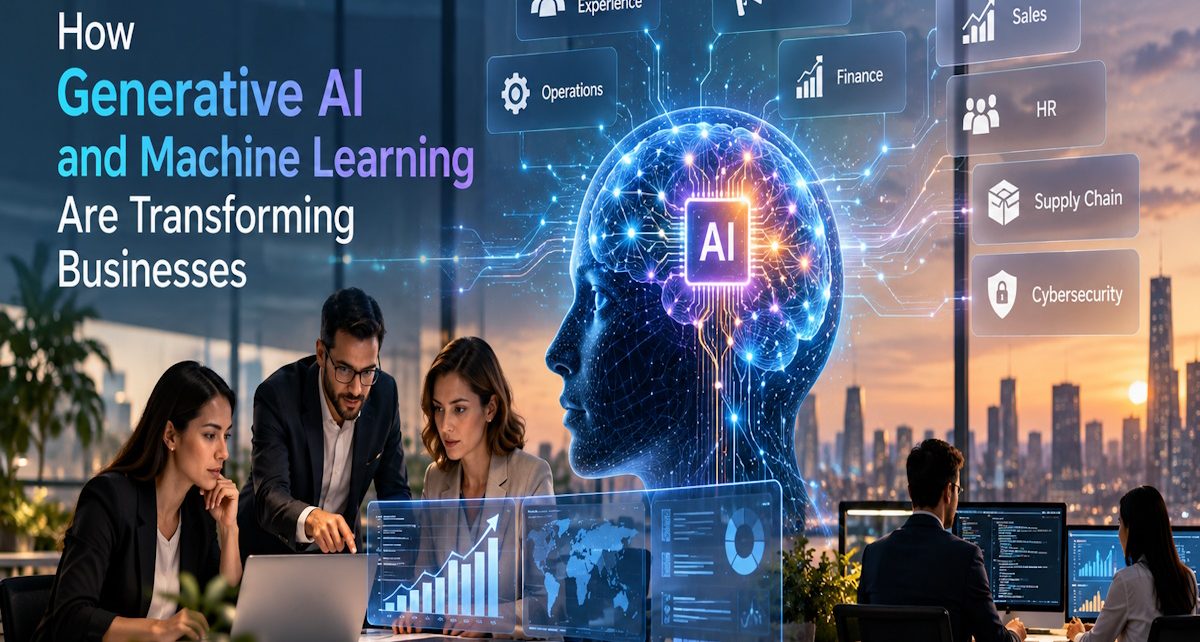
Their applications extend across customer service, marketing, software development, finance, sales, cybersecurity, and supply chain management.
Yet the strongest results rarely come from introducing technology everywhere at once.
They come from identifying a specific problem, selecting an appropriate solution, and measuring whether the outcome is better than the previous process.
A useful AI application should make work easier to complete, improve access to reliable information, or help employees make better decisions.
If it adds complexity without producing a clear benefit, the investment deserves another look.
Start with the processes your team finds frustrating. Examine where information gets delayed, where mistakes occur, and where employees spend time on repetitive work.
Then decide whether Machine Learning, Generative AI, or a simpler software solution can address the problem.
The businesses that gain lasting value won’t necessarily be those adopting the largest number of AI tools.
They’ll be the ones making careful technology decisions, measuring results, and keeping customer needs at the center of the work.
How Generative AI and Machine Learning Are Transforming Businesses
Businesses have spent years investing in software to make work easier. Yet employees still copy information between systems, spend hours preparing reports, and struggle to find useful insights buried in company data.
Generative AI and Machine Learning are starting to change that.
A sales manager can review months of customer activity without manually examining every record. A customer support team can resolve routine questions without keeping customers waiting. Developers can spend less time writing repetitive code and more time solving complex problems.
These aren’t distant possibilities. Businesses are already applying these technologies to everyday operations.
Still, there’s a difference between adopting AI tools and getting meaningful results from them. Adding a chatbot to your website won’t automatically improve customer satisfaction. Generating hundreds of marketing emails won’t help if the messages don’t address what customers actually need.
The real value comes from understanding where these technologies fit, what problems they can solve, and how to use them without creating unnecessary complexity.
Let’s explore what’s changing across different business functions and what you should consider before making your next technology investment.
Generative AI and Machine Learning: Understanding the Difference
Generative AI and Machine Learning are closely related, but they aren’t interchangeable.
Machine Learning focuses on finding patterns in data. Businesses use it to predict customer behavior, identify unusual transactions, forecast demand, and recommend products.
Think about an online retailer trying to estimate how many winter jackets it should stock. A Machine Learning model can examine previous sales, seasonal demand, pricing, and purchasing patterns to estimate future requirements.
Generative AI handles a different kind of work. It creates content, including text, images, code, and structured responses, based on patterns learned during training.
A retailer could use it to draft product descriptions, answer customer questions, or summarize inventory reports.
The distinction becomes particularly useful when both technologies work together.
A Machine Learning system might identify customers who are likely to cancel a subscription. A generative application could then help the retention team prepare personalized outreach based on approved customer information.
One technology identifies a pattern. The other helps people respond to it.
Of course, Generative AI itself relies on Machine Learning methods. The practical difference lies in what businesses ask these systems to accomplish.
Why Businesses Are Rethinking Their Existing Workflows
For many organizations, the biggest obstacle to growth isn’t a lack of software. It’s the amount of manual work required to keep existing systems running.
Consider a company where customer information sits in a CRM, invoices are stored in accounting software, and operational reports are maintained in spreadsheets.
Employees may need to move between these systems just to answer a basic question about customer profitability.
That takes time. It also increases the chances of missing information.
AI applications can help employees retrieve, organize, and interpret information without repeating every manual step.
But the opportunity isn’t limited to automation.
Businesses can also use these technologies to make better decisions, identify operational problems earlier, and deliver services that respond more closely to customer needs.
The starting point should be a business problem, not a software feature.
Ask a simple question: Which activities would produce better results if your employees had faster access to reliable information?
The answer often reveals opportunities worth investigating.
1. Customer Support Is Moving Beyond Scripted Chatbots
Traditional customer service chatbots usually follow predefined conversation paths.
They work reasonably well when customers ask predictable questions. Problems arise when someone uses unexpected wording or needs help with an issue that doesn’t match the available options.
Generative AI allows businesses to build conversational assistants that interpret questions and prepare responses using relevant information.
A customer might ask, “My package hasn’t arrived, and I’m leaving town tomorrow. What can I do?”
Instead of displaying a generic shipping policy, a properly connected assistant could check the order status, identify available delivery options, and explain the next steps.
That requires access to accurate order information and clear rules about which actions the assistant can perform.
The Opportunity Beyond Faster Responses
Customer service conversations contain useful information about products, policies, and recurring problems.
Machine Learning can categorize these interactions and identify patterns.
Suppose a software company receives a growing number of support requests after releasing a new feature.
Rather than treating each ticket as an isolated issue, the company can analyze the conversations to identify where customers are getting stuck.
Product managers can use those findings to improve the interface, revise instructions, or address software defects.
Customer support then becomes a source of product feedback rather than just a department that resolves complaints.
What Businesses Should Do
Start with a limited set of common support requests. Connect the assistant to approved information sources and define when it must transfer conversations to employees.
Measure resolution accuracy, repeat contact rates, customer satisfaction, and the number of issues requiring human intervention.
A lower support cost means little if customers repeatedly receive incorrect answers.
2. Business Decisions Are Becoming More Data-Driven
Most businesses collect more data than their employees can reasonably review.
Sales records, customer feedback, website activity, financial reports, and operational systems all produce information that could influence decisions.
The challenge is finding useful patterns before the information becomes outdated.
Machine Learning can help businesses identify relationships that aren’t immediately obvious through manual analysis.
For example, a subscription software provider might discover that customers who stop using a particular feature are more likely to cancel their accounts.
That finding gives the customer success team something specific to investigate.
They could contact affected customers, offer product guidance, or examine whether the feature has usability problems.
Generative AI can make these findings easier to access by allowing employees to ask questions in natural language.
A manager might ask, “Which customer segments had the largest decline in renewals over the last six months?”
A connected reporting assistant could retrieve relevant figures and prepare an explanation.
The Detail That Matters
An AI-generated explanation should never replace the underlying evidence.
Businesses need systems that show where answers came from, which data was used, and whether the results are complete.
For high-impact decisions, employees should be able to inspect the supporting records.
Otherwise, a convincing explanation may create more confidence than the evidence deserves.
3. Marketing Teams Can Produce More Relevant Customer Experiences
Marketing departments are under pressure to create content for multiple channels while maintaining consistent messaging.
Generative AI can assist with campaign planning, copywriting, audience research, and content variations.
But producing content faster isn’t necessarily the most valuable application.
The bigger opportunity lies in understanding which messages matter to different customers.
Machine Learning can analyze purchase history, browsing behavior, and engagement patterns to identify meaningful customer groups.
A software business, for instance, may discover that trial users who complete a particular setup process are more likely to become paying customers.
Instead of sending every trial user the same promotional sequence, the marketing team could create communication based on onboarding progress.
Customers who haven’t completed setup might receive practical guidance. Those already using the product could receive information about advanced features.
Generative tools can help prepare these messages while marketers review their accuracy, relevance, and tone.
Why Human Editorial Judgment Still Matters
Generated content often sounds acceptable at first glance.
Read it closely, though, and the problems become easier to spot.
The writing may repeat familiar claims, overlook customer concerns, or describe benefits without explaining how they work.
Strong marketing content needs more than correct grammar.
It should reflect actual customer questions, product knowledge, and the company’s position in the market.
Use AI to support research, develop outlines, and prepare early drafts. Let experienced marketers refine the argument, check claims, and remove content that adds little value.
Your audience doesn’t need more words. They need answers worth reading.
4. Software Development Is Becoming More Focused on Problem-Solving
Software development involves far more than writing code.
Developers review requirements, understand existing systems, troubleshoot problems, write tests, and maintain applications after release.
Generative AI can assist with several of these responsibilities.
Coding assistants can suggest functions, explain unfamiliar code, prepare documentation, and help developers explore possible solutions.
For an experienced developer, these capabilities can reduce time spent on repetitive tasks.
For someone working with an unfamiliar codebase, they may also make it easier to understand existing components.
But generated code needs the same scrutiny as code written by a person.
It may contain security weaknesses, incorrect assumptions, unnecessary dependencies, or logic that fails under unusual conditions.
The Growing Role of Custom AI Applications
Businesses are also exploring Generative AI Development to build applications that address their own operational requirements.
Consider a manufacturing company with thousands of equipment manuals, maintenance records, and troubleshooting documents.
Employees may spend considerable time searching for information about a particular machine.
A custom application could allow authorized technicians to ask questions and retrieve answers grounded in approved documentation.
The system could also provide references to the source material so employees can verify technical instructions.
This approach is often called retrieval-augmented generation, or RAG.
Rather than relying only on information learned during model training, the application retrieves relevant documents and uses them to prepare a response.
It’s particularly useful when businesses need answers based on private or frequently updated information.
Why Architecture Decisions Matter
A custom AI application requires careful planning around several questions.
Where will business information be stored? Who can access it? How will the application retrieve relevant records? What happens when the system cannot find a reliable answer?
Development teams also need to consider response time, operating costs, monitoring, and how the application will interact with existing software.
A well-designed system should be able to decline an unsupported request rather than invent an answer.
That behavior may seem less impressive during a demonstration, but it becomes essential when employees depend on the application for real work.
5. Financial Operations Can Benefit From Smarter Automation
Finance departments handle repetitive tasks that require accuracy and careful recordkeeping.
Invoice processing, expense classification, reconciliation, and financial reporting are common examples.
Machine Learning can help identify unusual transactions, categorize expenses, and detect patterns that may indicate errors or fraud.
Generative tools can assist employees with reviewing financial documents, preparing report summaries, and explaining changes between reporting periods.
Imagine a finance manager reviewing an unexpected increase in operating expenses.
A connected system could identify the categories responsible for the increase and summarize the supporting transactions.
The manager would still verify the findings before taking action.
Where Automation Needs Clear Boundaries
Financial processes often involve approvals, regulatory requirements, and confidential information.
An application that drafts an expense report presents different risks from one authorized to release payments.
Businesses should distinguish between systems that recommend actions and systems permitted to execute them.
For sensitive transactions, approval controls and audit records remain necessary.
Start by automating document classification or information retrieval before considering workflows that directly affect financial accounts.
6. Sales Teams Can Spend More Time With Customers
Sales representatives often spend hours updating CRM records, researching prospects, preparing follow-up emails, and summarizing meetings.
Some of that work can be supported by Generative AI.
For example, an assistant could turn meeting notes into a structured summary, identify unanswered customer questions, and draft a follow-up message.
Machine Learning can help sales teams analyze historical opportunities to identify characteristics associated with successful deals.
A business might discover that customers from certain industries require longer sales cycles or that specific product demonstrations are associated with higher conversion rates.
These insights can inform sales planning.
But there’s a risk in treating lead scores as unquestionable facts.
Historical data may reflect outdated sales practices or incomplete customer information.
Sales managers should review the factors influencing predictions and compare them with current market conditions.
The objective is to give representatives better information, not replace their judgment with a score.
7. Supply Chains Can Become More Predictable
Supply chain management involves decisions about purchasing, production, inventory, and delivery.
Small forecasting errors can create substantial costs.
A business that orders too much stock may face storage expenses and unsold products. Ordering too little can result in delayed deliveries and lost revenue.
Machine Learning can analyze historical sales, seasonal demand, supplier performance, and other relevant factors to support inventory planning.
Manufacturers can also use predictive maintenance models to examine equipment readings and identify patterns associated with potential failures.
Generative AI offers a different form of assistance.
Employees can use it to summarize supplier communications, search operational records, and prepare reports about delayed shipments.
Connecting Predictions to Real Decisions
A demand forecast is useful only when employees know how to act on it.
Suppose a model predicts higher demand for a particular product.
The purchasing team still needs to consider supplier lead times, warehouse capacity, purchasing budgets, and the cost of holding additional stock.
Businesses should design workflows that connect predictions to these operational constraints.
Otherwise, sophisticated forecasting tools may produce interesting reports without improving purchasing decisions.
8. Human Resources Can Improve Training and Internal Support
Employees frequently need information about workplace policies, benefits, training requirements, and internal procedures.
HR teams often answer similar questions repeatedly.
A generative assistant connected to approved company documents can help employees find information without searching through multiple portals.
The assistant might explain the steps for requesting leave or direct employees to the correct benefits documentation.
Generative tools can also support the preparation of onboarding materials, training exercises, and internal communications.
Machine Learning can help learning platforms recommend training based on job responsibilities and completed courses.
A More Practical Approach to Employee Learning
Consider a software company introducing a new development framework.
Instead of giving every employee identical training material, the company could organize learning paths based on experience and job requirements.
Employees might receive explanations, coding exercises, and practice questions suited to their current knowledge.
Managers could review training progress and identify areas requiring additional instruction.
Employment decisions deserve particular care.
Automated recommendations involving recruitment, promotion, or performance evaluation should be reviewed for accuracy, fairness, and compliance with applicable requirements.
9. Cybersecurity Teams Can Identify Problems Earlier
Businesses operate across cloud platforms, internal networks, mobile applications, and connected services.
Monitoring all that activity manually is difficult.
Machine Learning can help identify unusual login behavior, suspicious transactions, unexpected data transfers, and other patterns requiring investigation.
Generative AI can assist security analysts by summarizing alerts, organizing incident information, and explaining technical findings.
For example, an analyst investigating repeated failed login attempts could use an assistant to review related records and prepare an initial incident summary.
The analyst would then determine whether the activity represents a genuine threat.
Why Security Applications Need Extra Testing
Security-related outputs can be misleading when the underlying information is incomplete.
A system may incorrectly classify harmless activity as suspicious or overlook a genuine attack.
Generative applications may also be exposed to malicious instructions hidden inside documents or retrieved content.
Businesses should test how these applications handle untrusted information, restrict their permissions, and monitor their behavior.
Security teams need reliable evidence and clear escalation procedures, not just faster summaries.
10. Customer Experiences Can Become More Personalized
Personalization has traditionally relied on customer segments, recommendation engines, and predefined rules.
Machine Learning allows businesses to identify more detailed patterns in customer behavior.
An online retailer can recommend products based on previous purchases and browsing activity.
A streaming service can suggest content related to viewing preferences.
Generative AI introduces conversational interactions into these experiences.
Customers may be able to describe what they need rather than navigating through multiple categories.
Someone shopping for business software could explain their team size, existing tools, budget, and operational challenges.
A properly designed assistant could ask relevant follow-up questions and suggest suitable options based on verified product information.
The challenge is maintaining accuracy.
If an assistant recommends a product that lacks a required feature, the conversation may damage customer trust.
Businesses should connect recommendations to current product information and clearly distinguish confirmed features from suggestions.
The Hidden Challenges Behind AI Adoption
The benefits of artificial intelligence are appealing, but business results depend on several less visible factors.
Poor Data Can Undermine Good Technology
A forecasting model trained on inconsistent sales records may produce unreliable predictions.
A generative assistant connected to outdated policy documents may give employees incorrect instructions.
Before investing in complex applications, businesses should review the quality, ownership, and accessibility of their information.
Data preparation may not attract much attention during project planning, but it can determine whether the final application works as intended.
Operating Costs Can Grow Unexpectedly
Generative applications may incur charges based on usage, model selection, and the amount of information processed.
A system that performs well during a small pilot may become expensive when hundreds of employees use it throughout the day.
Development teams should measure cost per task, response time, and resource consumption.
Not every request needs the most capable model.
Simpler models, traditional software rules, or standard search functions may handle some tasks at a lower cost.
Choosing the right approach for each activity can help control long-term expenses.
Accuracy Needs to Be Measured
A demonstration showing five successful responses doesn’t prove an application is ready for business use.
Teams should test applications against realistic questions, incomplete information, unusual requests, and situations where the correct response is to acknowledge uncertainty.
For document-based assistants, evaluate whether answers are supported by the retrieved information.
For forecasting models, compare predictions with actual results over time.
For customer support systems, review whether customers receive correct answers and complete their intended tasks.
Testing should continue after deployment because business information and user behavior can change.
Employees Need Clear Responsibilities
Introducing AI can create confusion about who is responsible for reviewing outputs.
If a generated report contains incorrect information, who checks it before distribution?
If an assistant recommends an action, who approves it?
Businesses should define these responsibilities before expanding adoption.
Employees also need practical training on what the systems can do, where they may fail, and how to report problems.
A Practical Framework for Building an AI Strategy
Businesses don’t need to introduce artificial intelligence across every department at once.
A structured approach can help identify projects with measurable value.
Start With Workflow Analysis
Examine how employees complete important tasks.
Look for repeated manual steps, delays, data entry problems, and activities that require searching across multiple systems.
Talk to the people performing the work.
They often understand operational difficulties that aren’t visible in management reports.
Rank Opportunities by Business Value
Evaluate potential projects based on expected benefits, technical complexity, available data, and operational risk.
A customer support assistant handling common account questions may be easier to test than a system making financial decisions.
Choose an initial project where success can be measured and mistakes can be managed.
Establish a Baseline
Before introducing a new tool, record how the existing process performs.
Measure relevant factors such as processing time, error rates, customer satisfaction, or employee workload.
Without a baseline, it becomes difficult to determine whether the technology actually improved anything.
Build a Limited Pilot
Start with a controlled group of users and a defined set of tasks.
Test the application using realistic business information and collect feedback from employees.
Pay attention to unsuccessful interactions, not just successful ones.
Failures often reveal missing documents, unclear requirements, or problems with system access.
Evaluate the Full Cost
Include development, software subscriptions, cloud resources, maintenance, testing, security, and training.
Compare these expenses with measurable business benefits.
A project that saves employee time may still be difficult to justify if operating costs exceed the value created.
Expand Based on Evidence
If the pilot delivers useful results, increase its scope gradually.
Monitor performance as more employees begin using the application.
Continue reviewing accuracy, costs, security, and user feedback.
A successful pilot is a starting point, not proof that the same approach will work equally well everywhere.
What Businesses Should Expect Next
Artificial intelligence is becoming part of the software employees already use.
CRM platforms, accounting applications, development tools, and workplace systems are introducing features that help users retrieve information, prepare content, and complete routine tasks.
One area receiving attention is AI agents, which can perform sequences of actions rather than responding to a single request.
For example, an authorized system might collect information from approved sources, prepare a report, and submit it for employee review.
More complex systems could coordinate tasks across several applications.
But greater autonomy also creates new questions about permissions, error handling, and accountability.
Businesses should be cautious about allowing automated systems to make irreversible changes without suitable controls.
Another development is the use of smaller, task-specific models.
Not every business application requires a large general-purpose system. Some tasks can be handled by models designed for narrower requirements.
This may offer advantages in cost, response time, and control, depending on the application.
For business leaders, the important decision isn’t which technology receives the most attention.
It’s which approach solves a real operational problem at an acceptable cost and risk.
Making AI Work for Your Business
Generative AI and Machine Learning are giving businesses new ways to work with information, support employees, and improve customer experiences.
Their applications extend across customer service, marketing, software development, finance, sales, cybersecurity, and supply chain management.
Yet the strongest results rarely come from introducing technology everywhere at once.
They come from identifying a specific problem, selecting an appropriate solution, and measuring whether the outcome is better than the previous process.
A useful AI application should make work easier to complete, improve access to reliable information, or help employees make better decisions.
If it adds complexity without producing a clear benefit, the investment deserves another look.
Start with the processes your team finds frustrating. Examine where information gets delayed, where mistakes occur, and where employees spend time on repetitive work.
Then decide whether Machine Learning, Generative AI, or a simpler software solution can address the problem.
The businesses that gain lasting value won’t necessarily be those adopting the largest number of AI tools.
They’ll be the ones making careful technology decisions, measuring results, and keeping customer needs at the center of the work.
