

Last winter I lost an argument with a jar of pickles. My sister was in the kitchen, which made it worse. Two years of gym sessions behind me, a decent deadlift, and my hand gave out halfway through the twist like it had somewhere better to be.
I laughed it off, then thought about it all week. Because here’s the thing: I’d trained everything except the part of me that actually holds the weights.
Turns out I’m in good company. Hardly anyone trains grip, which is strange, because doctors have been measuring it for ages. The WHO uses it as one way to gauge how well older people are holding up, and there’s a 1999 JAMA paper where men with weaker grips in midlife were more likely to struggle with daily tasks years later. Does a gripper fix that? Nobody’s promising it does. Still, if your hands are weak for your age, you’d rather know, wouldn’t you?
One more thing before the list. “Grip” isn’t one skill. Crushing a jar lid, pinching a plate, dangling from a bar and opening your hand are all different jobs, and you can be good at one and terrible at another. So the eight exercises below try to cover the lot.
1. Squeezes with a digital hand grip strengthener
I’ll start with the one that actually changed things for me.
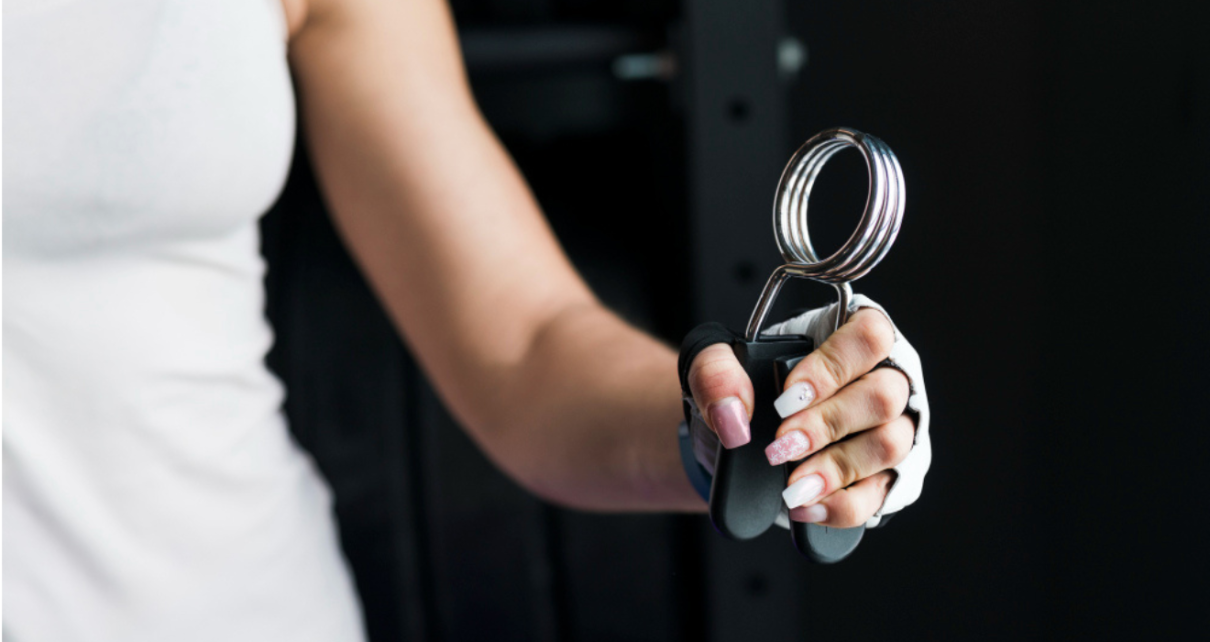
For years I owned a spring gripper that lived in a drawer. I’d squeeze it in front of the TV, feel a burn, and call that training. No idea if I was improving. A digital hand grip strengthener ends that guessing, because it shows you the force of every squeeze, on a little screen or in an app. The first week I used mine, the numbers told me something I’d never have felt: my left hand was about a fifth weaker than my right. (Roughly. I wrote it down, but don’t quote me on the decimal.)
Technique? Barely any. Squeeze, hang on at the top for a second, let the handles come back slowly. Don’t let them snap open. Stop when you’ve got a couple of reps left in you, not when you’re shaking. I do it two or three times a week, and I only test my max once in a while, sitting down with my elbow bent at roughly a right angle. Sit differently next time and the number’s useless.
2. Dead hangs
Grab a pull-up bar and hang. Honestly, that’s the whole exercise, and ten seconds will feel a lot longer than ten seconds. Don’t try to be a hero with one giant hold. A few short ones work better, and watch your shoulders, because they love creeping up toward your ears. When a full minute stops being scary, move to a thicker bar and enjoy being humbled again.
3. Farmer’s carries
Pick up two heavy things, walk. I’ve done these with kettlebells, dumbbells, and once with two buckets of paint, which I don’t recommend.
Chest up, 20 to 40 metres, turn around, repeat. Go heavy for short distances to build strength, lighter for long ones if you want endurance. Your upper back and core get hammered as well, which is why I’d keep this one even if I dropped everything else.
4. Plate pinches
Pinch a smooth weight plate between fingers and thumb and don’t let go. Simple, right? I once watched a guy with a handshake like a bench vice drop a 10 kg plate before he hit twenty seconds. His face said it all. Pinching just isn’t the same as crushing, and being good at one tells you nothing about the other.
Go lighter than your ego wants. Twenty to thirty seconds is a fine target. Those thumb tendons are slow learners.
5. Wrist curls and reverse wrist curls
Forearm on a bench, palm up, small dumbbell, curl it with only your wrist. Done? Now flip your hand and do it again.
Everyone does the first one. Almost nobody bothers with the second, and that’s the mistake. Your palm side is already busy all day, typing, carrying, gripping the steering wheel, while the back of your forearm mostly sits there. Ignore it long enough and it’s the part that starts aching, usually at the elbow. Use something light, go slowly, and stop around 10 to 15 reps.
6. Towel hangs
Throw a thick towel over the bar, hold both ends, hang. Soft and bulky means your hands have to work much harder to stay attached, which builds what’s called support grip. Even ten seconds is a lot harder than it sounds. Good step up from regular dead hangs.
7. Rubber band finger extensions
Rubber band around your fingers and thumb. Open your hand against it. Close slowly. Repeat.
Honestly, I nearly left this out because it looks like nothing. But almost every exercise here closes your hand, and this is the one that opens it. Couple of sets, 15 to 20 reps, maybe twice a week. Nothing dramatic. It’s also what I reach for when my forearms feel like wood and I need to loosen up first.
8. Wrist roller
Rope tied to a short bar, a light weight hanging from the end. Hold the bar out in front of you and wind the rope up with your wrists, then lower it with control.
Fair warning, it burns, and fast. Both sides of your forearm work non-stop, so you’ll be done sooner than you expect. Start with 1 to 2.5 kg and do one or two trips up and down. That’s honestly enough.
Fitting it into a week
Nobody needs all eight every session. I spread mine out: squeezes, hangs and the rubber band on one day, carries, pinches and reverse curls on another, then towel hangs, the roller and a quick go on the gripper (mostly to see if my number’s moved) on the third. There’s always a rest day between. Tendons heal slower than muscle, and I learned that the annoying way. If it’s a sharp pain, or it’s deep inside a joint, or it’s still there next morning, stop and let it settle.
What goes wrong
The classic mistake is training only the squeeze, since that’s the exercise everyone pictures when they hear “grip.” Pinching, hanging and opening get ignored.
Some people go flat out every session. Maximum efforts are useful occasionally. Constantly, they just irritate your tendons.
Others never look at the weaker hand. If your digital hand grip strengthener shows a gap, give that side an extra set.
And plenty judge progress by how tired they feel, which tells you very little. Write a number down.
Things people ask me
Is a digital hand grip strengthener really better than a normal gripper?
Not in the sense of making you stronger by itself. It’s the same squeeze either way. The difference is you can actually see what’s going on, which numbers went up, which hand’s behind, how last month compares. That’s the bit that got me to stop dropping the habit after two weeks.
How often should I train grip?
Twice or three times a week is fine. And keep in mind your deadlifts and rows are already working it.
How long before I notice anything?
About a month to six weeks, in my experience, before things feel a bit steadier in your hand. Tendons lag behind, so give it two or three months before you start loading heavier.
What if I’ve got arthritis or carpal tunnel?
I’m not a doctor, so I’d ask one first. Strengthening helps some people with hand problems, but the right plan depends on what’s actually wrong.
What’s a good grip number?
Depends on your age, sex, even your hand size. A single target for everyone isn’t much use, so I’d just compare you with you, tested the same way each time.
Where I’d start
Buy a digital hand grip strengthener, see where you stand, add two or three of the others, and keep notes for a couple of months. I’m fairly sure the pickle jar will lose next time.

