

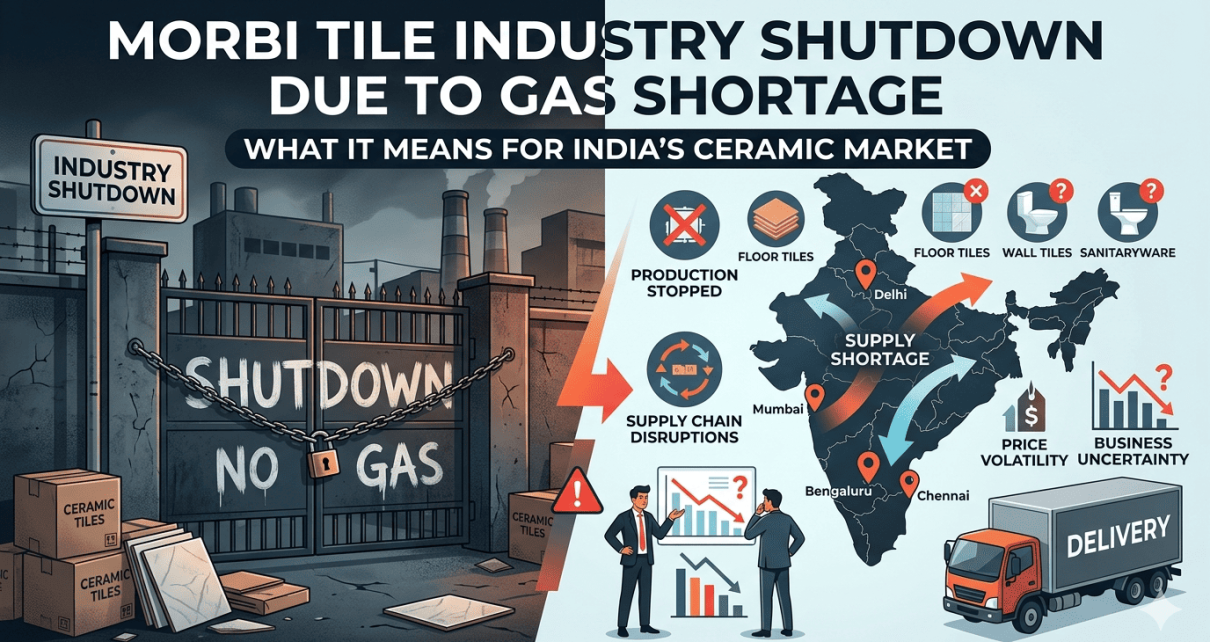
Industry sources confirm that around 550 out of 670 factories have halted production, while only a few piped-gas units remain partially operational. The shutdown is expected to extend beyond the initial April 10–15 target depending on gas supply conditions and the West Asia conflict situation.
Morbi is the ceramic capital of India and the world’s second-largest tile manufacturing hub after China. But in 2026, the city’s furnaces have gone cold — not because of a local failure, but because of a war thousands of kilometres away in West Asia. Gas shortages triggered by the Iran-US-Israel conflict have forced the majority of Morbi’s factories into an unprecedented shutdown, sending shockwaves through India’s construction and tile supply chain.
For builders, tile dealers, exporters, architects, and homeowners, this is not an abstract industry headline. It means delayed project timelines, higher tile prices, strained supply chains, and uncertainty that could last weeks or months. Morbi alone contributes around 80–90% of India’s ceramic and tile production and exports to more than 140 countries — any disruption here is felt nationally and internationally.
Why Morbi Is the Backbone of India’s Tile Industry
Morbi is a mid-sized city in Gujarat’s Rajkot district, situated on the banks of the Machchhu River, about 60 kilometres from Rajkot. What makes it extraordinary is not its geography but its industrial density — over 800 to 1,200 ceramic manufacturing units packed into a 60-kilometre industrial radius, producing everything from floor and wall tiles to vitrified slabs, sanitaryware, and industrial ceramics.
The scale is staggering. Morbi accounts for approximately 80–90% of all ceramic tiles and sanitaryware produced in India. The sector is valued at ₹65,000–75,000 crore annually, with about ₹50,000 crore serving the domestic market and over ₹15,000–20,000 crore exported each year. In 2024–25, Morbi exported ceramic products worth around ₹15,000 crore to markets including the United States, France, Germany, Oman, and Sri Lanka.
What truly sets Morbi apart is its complete ecosystem. Raw material suppliers, kiln machinery companies, logistics providers, packaging units, export agents, and a deep pool of skilled labour all coexist within a few kilometres of each other. This integrated supply chain is why Morbi became the world’s second-largest ceramic hub — and also why a single fuel disruption has such catastrophic consequences.
How Many Tile Factories Are There in Morbi?
Morbi has approximately 670 registered ceramic factories according to the Morbi Ceramic Manufacturing Association. Broader industry estimates, which include smaller and ancillary units, place the total above 800 and in some counts above 1,200 production units across the Morbi district and surrounding industrial zones within a 60-kilometre radius.
The variation in factory counts exists because the ceramic cluster is not confined to the city limits — it spreads across Morbi taluka, Wankaner, and several satellite industrial areas. When smaller MSME units, job-work facilities, and ancillary manufacturers are included, the number rises significantly. The Morbi cluster alone consumes roughly 55 lakh cubic metres of propane and 25 lakh cubic metres of natural gas every single day during normal operations — a scale that underscores just how dependent this region is on uninterrupted fuel supply.
Why Are Morbi Tile Factories Shutting Down in 2026?
The root cause is the ongoing military conflict involving the United States, Israel, and Iran in West Asia. The Strait of Hormuz — a narrow waterway through which a significant portion of the world’s energy shipments pass — has been effectively closed to commercial vessel traffic since the conflict escalated. This single chokepoint controls the movement of propane, LNG, and other fuels that power Morbi’s kilns.
Ceramic manufacturing is energy-intensive by nature. Tile kilns must operate continuously at temperatures of nearly 1,200 degrees Celsius. Any interruption in fuel supply cannot simply be paused and resumed — it affects the entire production cycle. Here is how the crisis unfolded step by step:
Are 97% of Morbi Tile Factories Really Shut Down?
The 97% figure refers to the proportion of Morbi Ceramic Manufacturing Association members who voted in favour of a collective shutdown — not the share of factories currently operating. However, multiple credible sources including Business Standard, Business Today, and BBC confirm that approximately 550 out of 670 registered factories (around 80–82%) had physically halted production by late March 2026, with the number continuing to rise.
The Morbi Ceramic Manufacturing Association president Manoj Arvadiya confirmed to media outlets including PTI and Business Standard that 430 units collectively voted to shut until April 10–15. Business Today quoted association adviser Mukesh Kundariya saying approximately 550 factories had halted production, with only a few piped-gas units remaining partially operational. As gas stocks deplete further, those remaining units are also expected to cease operations.
The exact percentage changes daily as more units exhaust remaining fuel stocks. What is clear from ground reports is that Morbi is experiencing the largest simultaneous factory shutdown in its industrial history.
Current Condition of the Morbi Ceramic Industry
The on-ground situation in Morbi as of April 2026 is one of near-complete industrial paralysis. Here is what is happening across different stakeholder groups:
Factory Owners
Most are using the enforced downtime for kiln maintenance. Many are exploring PNG connections and alternative fuels such as coal gasifiers. Financially, owners can sustain wages for a few months but not indefinitely.
Workers
A large number of migrant workers are returning to their home states. The shutdown puts approximately 4 lakh direct factory employees and nearly 9 lakh total livelihoods at immediate risk.
Exporters
Finished goods ready for dispatch are stuck. New export orders are on hold. Logistics costs have surged by 25%. Buyers in the Middle East, Africa, and Europe are looking at alternative suppliers.
Transporters & Ancillaries
Truckers, packaging units, raw material suppliers, and local traders are all experiencing revenue drops. The broader Morbi economy — including local shops and services — is feeling the impact.
Industry leaders are formally requesting the government to approve alternative fuel sources including coal gasifiers, and to expedite PNG network expansion into more factory areas. Former Morbi Ceramic Association president Khimji Kundariya has called on the central government to accelerate its green hydrogen mission as a long-term structural solution to reduce dependence on imported fuels.
How Will the Morbi Shutdown Affect Tile Prices Across India?
The price impact is already visible. Industry sources confirm tile prices have risen by ₹2–₹3 per square foot even before the full extent of the production halt has played out. When factories eventually restart, the higher fuel costs will be built into new production pricing — and analysts suggest that figure could reach ₹5–₹10 per square foot more for tiles manufactured post-shutdown.
| Impact Area | Short Term (Now) | Medium Term (If Crisis Extends) |
|---|---|---|
| Tile prices | +₹2–3/sq.ft already | +₹5–10/sq.ft on new stock |
| Tile availability | Existing stock still available | Serious shortages of vitrified, wall & large-format tiles |
| Project timelines | Minor delays possible | Significant delays for builders and developers |
| Import alternatives | Higher costs, longer lead times | China, Spain, Italy tiles more expensive due to logistics |
| Export business | Existing orders stuck | Buyers shifting contracts to competitors — may not return |
Cities with heavy dependence on Gujarat tiles — Hyderabad, Mumbai, Delhi, Bangalore — are already experiencing early signs of supply tightening. Tile dealers report that procurement timelines are stretching and some specific SKUs are becoming difficult to source at previous prices.
Can Morbi Recover from This Crisis?
Morbi is not a stranger to adversity. The ceramic hub has survived the Covid-19 pandemic, sharp anti-dumping duty disputes in export markets, previous cycles of high energy prices, and multiple economic slowdowns over its decades-long rise. Each time, the cluster’s deep manufacturing ecosystem, entrepreneurial workforce, and competitive cost structure have enabled it to bounce back.
However, this crisis is structurally different from previous ones. The fuel dependency that powered Morbi’s rise — transitioning from coal to cleaner propane and natural gas over the past decade — has become its most acute vulnerability. The industry’s own leaders are now acknowledging that long-term resilience requires a fundamental rethink of the energy model.
Industry experts and the Gujarat government have both expressed concern and are reportedly in discussions about alternative supply arrangements. Morbi remains one of the most competitive tile manufacturing clusters in the world by cost, scale, and design capability. Once fuel supply improves, most factories are expected to restart production — though the pace of recovery will depend on how long export contracts hold and whether migrant workers return.