

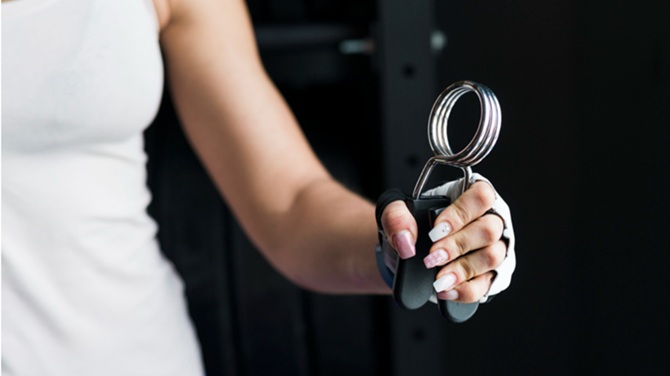
Somewhere in most offices, a hand gripper is gathering dust in a drawer. Bought with good intentions, squeezed for a week, forgotten. It’s a shame, because crush grip, the closing squeeze of fingers against palm, is one of the easiest strengths to train and one of the easiest to train badly.
Badly means half-closing the handles, letting the index finger do all the work, squeezing until you’re bored and having no idea afterwards whether anything changed. Here’s how to avoid that, and how a digital hand grip strengthener takes the guesswork out of the last part.
Where the handle goes
Rest the fixed handle deep in your palm, close to where your fingers begin. If it creeps towards your fingertips it slips on every squeeze. Pushed in too far, it digs in.
Now close it, starting with your little and ring fingers and letting the rest follow. The index and middle fingers usually take over, since they’re the strong ones, and that leaves the little and ring fingers weak. They’re the limit on your crushing power, so they’re the ones to train.
Only count a rep if the handles meet. Stop short and it still feels like a rep, but you’re training your hand to quit before the end. A quick phone video of a set will show gaps you can’t feel. And if your digital hand grip strengthener displays a peak reading, look at it after each squeeze. A sloppy one shows up as a lower number, however it felt.
Sets, reps and rest days
Begin lighter than your ego wants. Three sets of eight to twelve per hand, resting around ninety seconds between sets, on two days a week with a gap between them. Muscle gets stronger quicker than tendon does, so your forearms will feel ready for more before the tendons actually are. Pick a resistance where the last couple of reps are a proper fight but the handles still close.
Once you can get through three sets of twelve clean reps, go up a setting. Change reps or resistance, not both in the same week, otherwise you won’t know which one helped or which one caused the sore elbow. Later on you might move to four harder sets of six to eight, with a light warm-up set first.
Add some opening work as well. Loop a rubber band round your fingers and spread them against it, three sets of fifteen to twenty-five. Dull, I know. But the muscles on the back of the forearm get ignored by all that squeezing, and elbows tend to complain eventually.
Every six to eight weeks, cut the volume by about a third for a week. It feels like slacking. It isn’t.
What the digital version adds
A spring gripper tells you which setting you’re on and nothing else. Between settings is where most real progress hides: a couple of kilos here, a better left hand there. A digital hand grip strengthener makes those small gains visible, so you don’t have to take your own word for it.
Test it properly or the numbers are just noise. Testing every week or two is plenty. Do it the same way each time: same posture, thirty to sixty seconds of rest between all-out squeezes, two or three attempts per hand with the best one recorded. Go first thing in a session, while your forearms are fresh, and log both hands. If one is clearly behind, that’s where the extra work goes.
Is it worth the bother?
There’s a decent reason beyond looking tough. In the PURE study, which tracked about 140,000 adults across 17 countries, every 5 kg drop in grip strength lined up with a 16% higher risk of death from any cause and a 17% higher risk of cardiovascular death. That doesn’t mean a gripper will extend your life. Weak grip may simply flag something else going on. Still, it’s cheap to measure and worth keeping an eye on.
Ways people mess this up
Training every day. The tendons grumble first and loudest. Going for a max just before deadlifts or pull-ups is another, and then the bar slips and you wonder why. Plenty of people favour their strong hand because it’s more satisfying. Training through pain is the worst of the lot. Sharp pain, tingling, or weakness that doesn’t clear up: stop and get it looked at. A dull elbow ache is a gentler warning, so do less, add the band exercises and come back up gradually. If the knurling rubs your skin sore, try a bit of chalk. Calluses will form in time.
In short
Handle deep in the palm, little finger first, every rep closed fully, rest days built in, and an occasional test done the same way each time. A digital hand grip strengthener handles that last bit for you. Give it two months and you’ll know, instead of hoping, whether your crushing power has actually improved.


