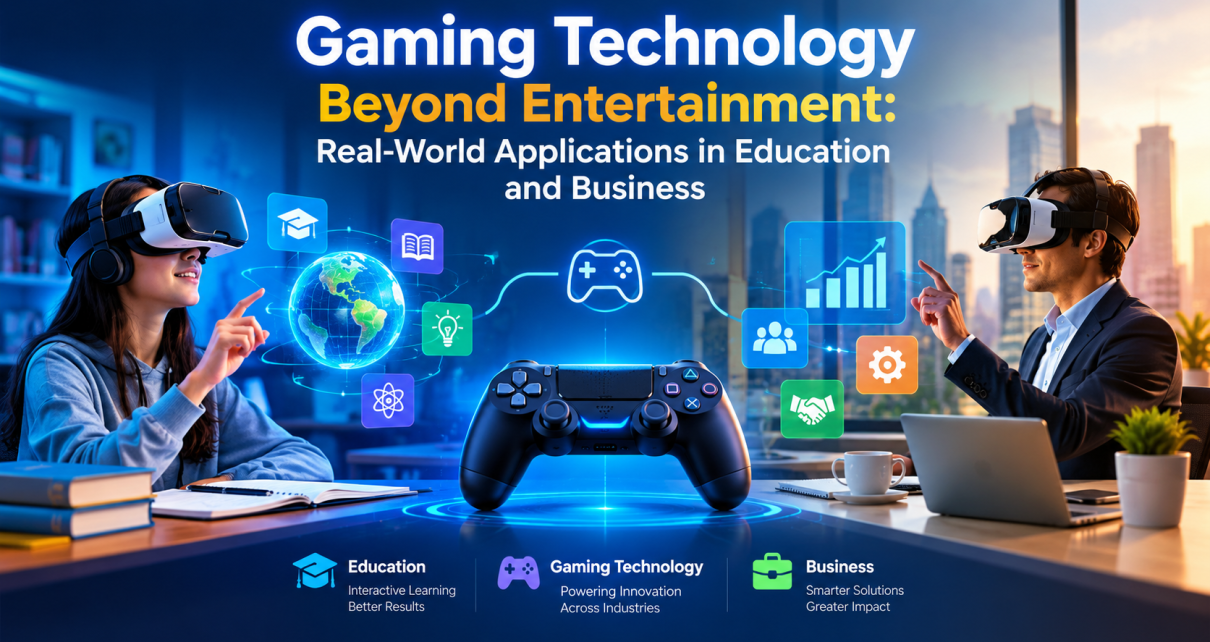
Before I used to take the view that games were a tool you used when you had finished the business of business. From then on I began to see how often the actual work was based on games. The badges were awarded in a maths applications by a relative. A new company that a good friend of mine joined on my ship used to bring them in using a points-based quiz and following with a leader board. Even IRL budgeter-aholics like myself have streaks! Technology for gaming has quietly out of the living room and into classrooms / offices and why it continues to work.
Why Games Capture The Focus of A person
Have you been caught on a level before? I bet you didn’t stop! You went back to basic, developed new strategies and tried again. But that never-ending-feedback-attempt-retry cycle is what powers almost all good games and, quite naturally, it’s the way people learn best.
Feedback is usually postponed in the traditional teaching. You subscribe to an assignment, and the following reply comes after a week. A game indicates in seconds if you are correct. It also maintains that challenge on the edge of your level to make you feel challenged but not overwhelmed. This is what designers call “flow”, and after realizing that you begin to see it all around.
Playing games in the classroom
One of the most creative groups of adapters have been teachers. Students who are reluctant to speak up get to participate when the questions are written on a screen in a live competition format. Language Apps doesn’t let people forget about the vocabulary. Coding games allow children to compose genuine logic and then drag a character through a maze, which means they get to learn the coding without first sitting in a lecture.
It’s also great if popular franchises can help. Imagine a teacher using game activities that involve collecting different creatures to make classification-it makes sense concepts. For instance, in dragon pokemon, students can categorize them by dragon category, compare good points and bad points of each dragon, and compile a table that defines the benefits of each dragon based on their fighting styles. It’s fun, but under the surface they’re practising some sorting and comparing data and justifying an argument using evidence. Youngsters that never spontaneously engage in a discussion about a biology chart will happily argue which dragon should be on the team.
Finally, when using game-based assessment, teachers’ reading of progress is altered. There are no end-of-term exams, but a multitude of small results indicating that this or that concept posed a challenge to a student on Tuesday. That also gives them notice so they can make an early comin’. There are the students, that are on the other hand, see that failing is part of the game and don’t think it implies they are unable, which helps their self-confidence.
Simulations, VR and Hands-On Training
In a few skills, it is not cost-efficient, unsafe or uncommon to actually perform the skill. Flight simulators have been used to train pilots for decades and it’s doing so much more than that now. Complications have no risk and medical students practice their techniques in a virtual environment. Apprentice electricians must be able to perform work on live systems, which pose no danger of shock. Performing a warehouse layout in a worker-friendly interface before moving onto the floor.
This has become more affordable and believable with virtual and augmented reality. With a good sound system and quality engine, a “call center” or a “test lab”/“production line” can be reproduced. I’m intrigued with the insights that these tools provide. Each delay or misjudgment is noted, allowing trainers to be able to tell where the person is getting “stuck” rather than assuming.
There’s an inclusion angle, as well. The learner who is shy to speak up in the real workshop can practise privately and repeat, as many times as he/she wants.
How game mechanics are used in businesses
Businesses learned that it is the job of every individual to follow and recognize progress. Leader board and challenges keep the momentum alive for your sales teams. The faster and higher rated a resolution, the more points that will be awarded in the customer support department. Wellness programs offer walking or sleeping streaks to employees who actively engage with the program. Learning how to comply, the biggest hour of the year, turns to be a tolerable hour when there’s a scenario in which your choice is changing the outcome.
This was more pertinent with the shift to remote working. A guided scenario with immediate feedback is one component in bridging the gap when a new hire is unable to sit next to another staff member to learn and observe their work. It is not a substitute for mentoring, but it does provide people with something concrete to do on day one, rather than reading through a handbook.
Gamification is not all about employees. Loyalty programs and tiers with chips and rewards are marketing methods used by brands to incentivize the return of their customers; meanwhile, the little surprise is employed in the apps to return the customer. Not only that, game engines are used to drive product design as well: architects are able to show clients unbuilt buildings and walk them through them; car makers can show and real-time render car interiors before anything is built. It appears that fantasy world is also effective in rendering a showroom.
Engaging, Small Interactive Tools
It’s not necessarily a high-end application that has to have a headset or a huge budget. It is possible for lightweight interactive tools to perform some surprising functions. For instance, a Favorite Pokemon Picker. At its face level, it’s a simple little instrument that allows you to select a favourite from a long list. However pay close attention to the mechanics, the options are whittled down rapidly in comparison which is a product testing, design review and classroom debate decision-making tool.
That might be a good way that a teacher could start a lesson about preferences and reasoning, asking students how they made their decision. The same concept may be used successfully by a marketing team to poll and have the audience participating and sharing the poll. Let the user do little work; get him to do a lot of work. It’s this combination that makes these little interactive widgets so effective, and so’s why I’m keen to watch them.
A set of enforcement challenges that could not be ignored
There’s no magic involved in any of this. The problematic design can make gamification look like a game with hidden mechanisms, while meaningless points take its toll quickly. But if there’s only a top three on the leaderboard, everyone else doesn’t care. Access also counts; it is impossible for all schools and small businesses to support audiovisual equipment or computing equipment of high quality, and privacy issues arise if training devices monitor the volume and nuances of behaviour. Another is also time – creating quality scenarios requires work, and teams tend to underestimate that.
The goals should be kept as the primary consideration and the game secondary. Decoration won’t save the activity if it does not promote learning or working in a way. Decoration will not save an activity if it does not facilitate learning or working in some way.
Where is this going?
AI is already personalizing the difficulty to the learner while cloud streaming is reducing the hardware restrictions. More training that sounds like fun, and more workplaces that are like a great game. We were taught how to design for the attention span in entertainment—now some aspects of the design process are being used by other fields as well.
It could be a student filling in a dragon pokemon chart, a nurse doing her role play, or a team choosing a favorite with a fast tool — it’s the same pattern. The audience responds when it can move, get feedback and see movement. Games did not need this to be taught to them. The others are now in the wake of us.